This site displays best on a computer vs a smaller device. Please REFRESH page each time you visit
History of Pool Branch 1874
Excerpt from 1979 Burnet County History, Vol. I, page 128
This matenal was researched. written, and submitted by Mrs. Estelle A. Bryson.
The Pool Branch community was located just north of the North San Gabriel River some seven miles north of Bertram. The stream for which it was named, Pool Branch, heads on what is now Ranch Road 963 and empties into the North Gabriel about one-fourth mile west of the Joppa Bridge. About one-half mile upstream from the Gabriel on Pool Branch, there is a natural waterfall that falls into a mill pond.
Here a gin was built and operated in the 1880s, and could gin about 10 bales of cotton a day. A mill was also operated and ground corn. (In 1886 cotton was selling for two cents and
three cents per pound, and corn was 15 cents per busheJ.)
The gin was operated by George Livingston, who camped at the gin. His helpers were Boone and Teal Stevenson. The gin had two stands and operated for a good many years.
The community also had a store and a blacksmith shop a few hundred yards southeast of the gin on the west side of the present county road about halfway to the schoolhouse.
Mrs. Hattie Snow Smith had a hat shop in her home about one mile east of the gin and store. Mrs. Smith and Emma Barnett made a trip to St. Louis for milliner training. Mrs. Smith bought the mirror for her shop at Stokes Brothers in Lampasas.
On August 31, 1881, J. S. Danford and wife, Jane Danford, County of Delaware, State of Iowa, gave two acres of land from the northwest corner of the Douglas Brown Survey on the north bank of the North San Gabriel River to the County Judge of Burnet County and his successors in office to be used as a school and a church lot, provided a sufficient schoolhouse be built and completed by the first day of March, 1882; and "if said house is not completed by said date the land shall again become the property of said Danforth and wife. " The school was built and was used for that purpose and also as a church for many years.
A post office was established in 1891, and the name given it was "Joppa." By 1910 the name "Pool Branch" was no longer used for the community. There are a few stones left where the store and blacksmith shop stood, also perhaps a few pieces of iron where the gin stood, and the Joppa Community Center is where the school stood.
Texas Historical Commission. (Historical Marker Number 9722.)
Some of the first settlers in this farming and ranching community were the William Alexander Faires family in 1874 and the Martin Luther Ater family the next year. The settlement was called "Pool Branch" for a nearby pool formed by a waterfall. In the 1880s a cotton gin and mill were located on the pool which was known as "Mill Pond". There was a store, a blacksmith shop, and one mile from the gin, Mrs. Hattie Snow Smith ran a hat shop in her home.
J. S. and Jane Danford of Delaware County, Iowa, gave two acres in 1881 for a school and church, provided the schoolhouse was completed by March 1, 1882. Area residents met the deadline.
With the establishment of a post office in 1891, the community's name changed to the biblical, "Joppa". William F. Childers served as the first postmaster. After the coming of rural mail delivery, the post office closed in 1904.
Worship was held in the Joppa Schoolhouse until 1913 when the Joppa Baptist Church congregation erected this meetinghouse. The Joppa School consolidated with Bertram in 1942. All that remains of the pioneer settlement is the church house and school building which serves as a community center.
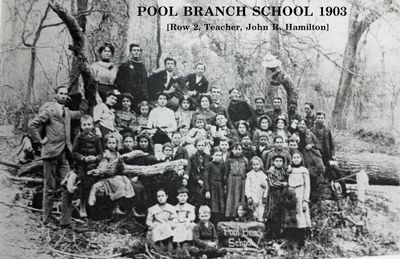
Pool Branch School 1903
Joppa School - formerly Pool Branch School
JOPPA SCHOOL formerly POOL BRANCH SCHOOL
The school at Joppa was started some time in the 1880s as the POOL BRANCH SCHOOL, and the name was changed some time around 1900 to the JOPPA SCHOOL.
On August 31, 1881, Mr. and Mrs. J. S. Danford of Delaware County, Iowa, deeded two acres to the County Judge of Burnet County to be used for a school and a church. If a building was not built for a public free school by March 1, 1882, the land would revere to the grantors (Volume N, Pages 506-507, DRBC). This was the land upon which the school house was built, and it has always stood at the same place. The JOPPA SCHOOL was listed as school #3 of Common School District #4.
The first school building burned during the 1889-1890 session when Jennie Faires was the teacher. Other early teachers were Miss Ollie Cushingberry, a Mr. Brown, and it is thought T. S. Reed.
1941 the school was consolidated with Bertram.
Click here to view Class Photos of Pool Branch and Joppa School above
Photo in gallery above: JOPPA SCHOOL-April 18. 1930. Students & Teachers
Back row (I to r) Armour Brooks (Barnett), teacher. Odell Price, Ruth Chapman. Lonnie Cox, Laura Cox, Jay Chapman, Ozelle Asher. Charlie Butcher, Ophelia Russell. Earl Key. Gladys Huggins (Teague). Walter Butcher, Carrie Maud Huggins (Banks), Oran Price, Mrs. R. M. Turner-teacher.
Second row from back (I co r) __ Blaylock, Luther Acer. Ella Faye Crawford , Buck Asher. Theatious Johnson. W. W. Taylor. __ Blacklock, Vera Mac Johnson. Raymond Dale Price. Thelma Crawford, Ernest Francis Allen (Buster), Wachweese Baker, Odell Huggins, Malcolm Blacklock.
Third row from back (I ro r) Raymond Crawford , Morris Price, Mary Lou Asher. Francis Cox, Eleanor Davis. Dorothy Nell Chapman. Ruby Lee Johnson. Dorothy Mac Acer. Glen Dora Crawford , Hazel Kate Price. Charlda Baker. La Verne Chapman, Juanita Huggins (Baker). Yates Johnson. J. W. Huggins.
Front row (I ro r) Mildred Crawford , Margaret Asher. Elvin McDaniel. Johnnie Mac Davis, Carlos Joe Price, George Gale Price. Elsie Faye Turner. Ozias Johnson.

more history to come
We hope to add more images and family stories - please send to toni.schmid@gmail.com
Pool Branch est 1874
https://www.hmdb.org/m.asp?m=27539
Some of the first settlers in this farming and ranching community were the William Alexander Faires family in 1874 and the Martin Luther Ater family the next year. The settlement was called "Pool Branch" for a nearby pool formed by a waterfall. In the 1880s a cotton gin and mill were located on the pool which was known as "Mill Pond". There was a store, a blacksmith shop, and one mile from the gin, Mrs. Hattie Snow Smith ran a hat shop in her home.
Bertram Depot est 1882
https://www.hmdb.org/m.asp?m=203266
When the Austin & Northwestern Railroad first laid rails through Bertram in 1882, the original Bertram depot was constructed on this site and served railroad passengers until the end of passenger service in 1937
Bertram School est 1882
https://www.hmdb.org/m.asp?m=27427
When Bertram was founded in 1882 along the Austin & Northwestern Railroad, one of the first structures erected was a combination school, Sunday School, and Masonic Lodge hall. Rudolph Bertram, Austin Railroad executive for whom the town was named, contributed $50 for construction of the school. The frame building was enlarged as the community grew. By 1908, however, new facilities were needed for the 264 students.
Schools in the area
Old Strickling School is thought to have begun about 1869 and ended around 1895. It was listed in School District #4 and later in 1911 Shell Rock, Shady Grove, and Joppa Schools were all listed in Strickling District #4.
Source: Burnet County History, Volume I